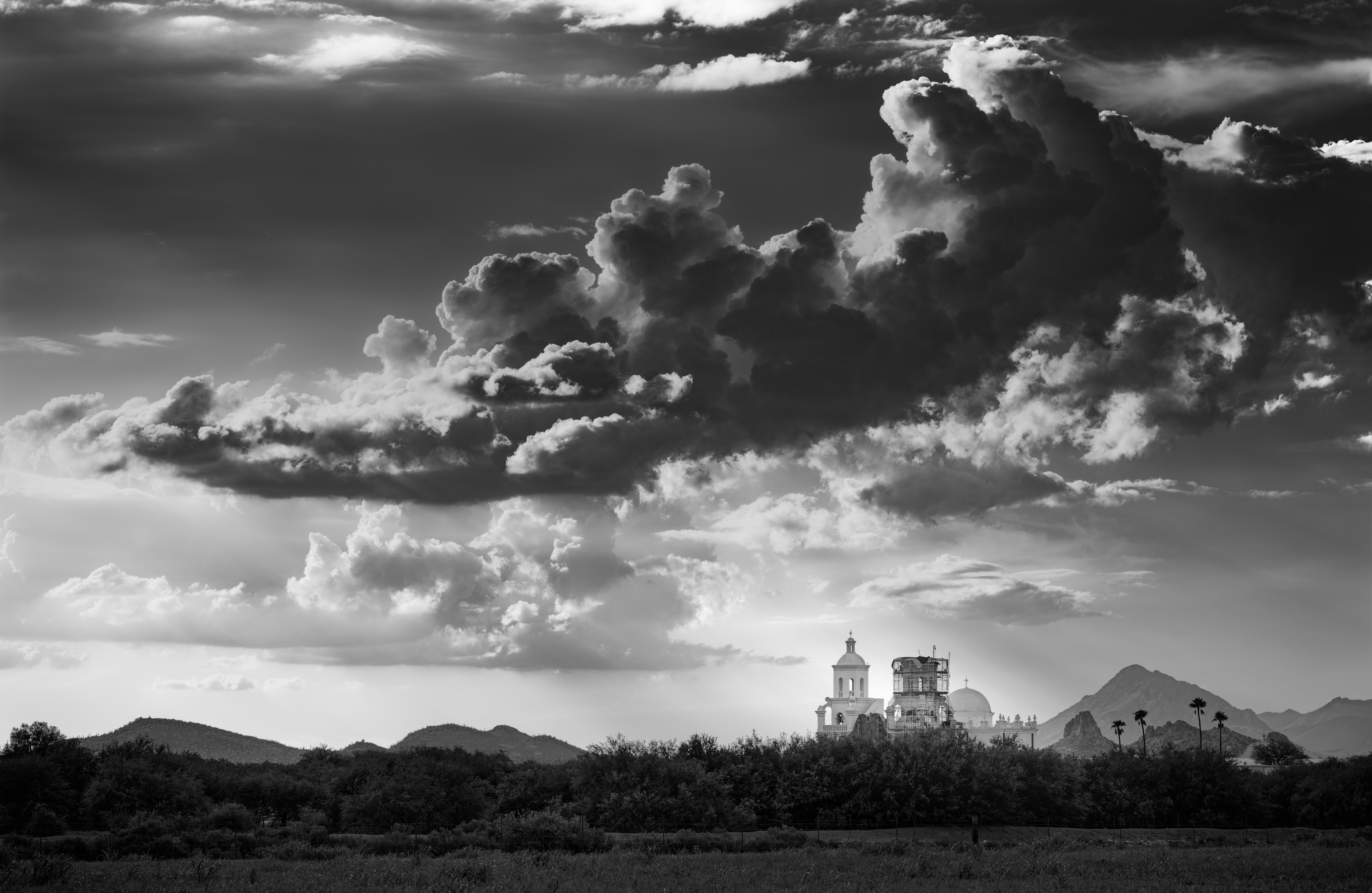
Across the field, where white cotton grows,
A hazy line defines the verdant plain,
And there, a vision from the earth upsprings,
Where Tucson's light its storied beauty throws.
From heavy cumulus, a glory flows,
As God-rays pierce the sky, like silver rain,
And on the desert's canvas, stark and clean,
The White Dove of the Desert softly glows.
The carved façade, a pearly, holy sight,
It draws the gaze beyond the tilled expanse,
A silent promise in the waning light,
A sanctuary holding time's slow dance.
It stands afar, a relic stark and grand,
As when the last of them released its hand.
If you stand at the edge of the silver-green cotton fields south of Tucson, and just west of the present day I19, you will see a miracle of lime and stone rising like a cloud from the dust. This is San Xavier del Bac, the "White Dove of the Desert." But to see it today—shining, restored, and proud—is to forget the long, lonely century when the desert almost reclaimed it.
The Birth of the White Dove
The story begins in the late 1700s, with the rhythmic clinking of chisels and the sweat of the Tohono O’odham laborers. Under the direction of Franciscan friars, they raised a cathedral that shouldn’t exist in such a wild place. Its façade was a riot of ultra-baroque carving, and its walls were brilliant white, reflecting the "God-rays" that pierce the heavy monsoon clouds.
But by 1797, the work abruptly slowed. Money had run dry, or perhaps the soul of the architect had grown weary? The East Bell Tower was left unfinished, capped with a flat roof instead of a gleaming dome. It stood as a "relic stark and grand," a silent testament to a dream interrupted.
The Releasing of the Hand
The true "abandonment" came in 1828. Following Mexican independence, the new government ordered the expulsion of all Spanish-born priests. One morning, the last friar gathered his few belongings, looked back at the pearly, holy sight of the mission, and "released its hand."
For the next thirty years, the White Dove sat in a "hazy line" of silence. The desert wind howled through the empty nave. Dust settled over the vibrant frescoes of the saints. To the outside world, San Xavier was a ghost, a crumbling sanctuary holding a "slow dance" with time.
The Guardians of the Silence
Yet, the mission was never truly abandoned. While the priests were gone, the Tohono O’odham people of the village of Wa:k never left. They became the silent guardians of the White Dove. They hid the sacred gold vessels and the statues of the saints in their own homes to protect them from looters. They patched the roof when the monsoon rains threatened to melt the adobe. They kept the "silent promise" of the mission alive in their hearts until the world finally returned to find it.
The Vision Through the Scaffolding
When you look at my photograph of the mission today, note the modern scaffolding clinging to that unfinished East tower, you are seeing a bridge across time. That scaffolding isn't just about construction or restoration; it is a physical embrace, a way of finally finishing what was started centuries ago brought by the efforts of the Patronato San Xavier organization
It is the view the last friar might have seen in his mind's eye as he walked away—a vision of a church that refuses to fall. Even with its "stark and clean" canvas and its missing dome, the White Dove remains the soul of the Sonoran, glowing softly against the "waning light" as a reminder that what is truly sacred is never truly forgotten.