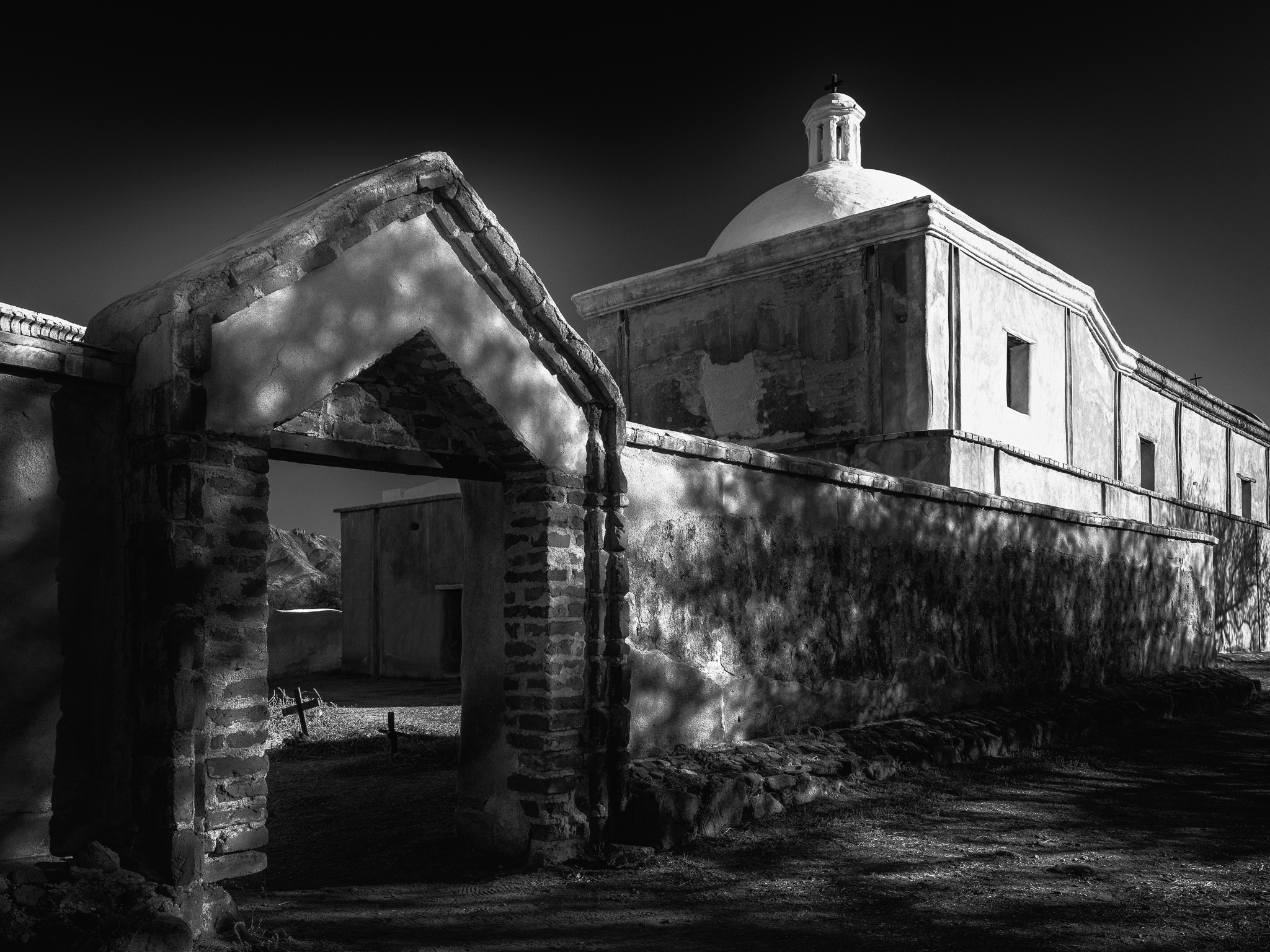
The adobe archway frames the fading light,
Where wooden hinges rotted long ago.
No iron bars obstruct the traveler’s sight,
Just empty space where desert breezes blow.
The cross remains, by sun and sand distressed,
Within the silence of the hallowed yard.
With silvered skin and fibers deeply pressed,
It keeps a vigil, weary and unbarred.
The setting sun descends with tender grace,
To brush the wood with beams of liquid gold.
It warms the hollows of that weathered face,
As desert shadows over earth unfold.
Though time has claimed the gate and worn the wood,
The light still finds where once the spirit stood.
Today to stand before the Puerta del Cementerio at Tumacácori as the sun begins its "tender grace," you would be looking through a ghost of an entrance. The adobe archway stands firm, but the "wooden hinges rotted long ago," leaving only empty space where a heavy gate once guarded the sleep of the mission’s people.
While San Xavier del Bac was shielded by the constant, protective presence of the O'odham, Tumacácori’s story is one of a long, lonely silence.
The Great Departure
In the winter of 1848, the world at Tumacácori simply became too harsh to endure. After years of relentless Apache raids and a winter so cold the crops failed, the last of the residents made a heartbreaking choice. They didn't just walk away; they gathered their most sacred possessions—the hand-carved santos (saints) from the altar—and carried them on their backs.
They walked forty-five miles north to join their kin at San Xavier. It was this act that saved the statues but left the mission of San José de Tumacácori "unbarred" and vulnerable.
The Years of the Unprotected
Unlike the "White Dove" near Tucson, which was never truly alone, Tumacácori was left to the mercy of the "howling desert gale" and the greed of men. For decades, the mission became a waypoint for travelers who saw the hallowed cemetery not as a sacred yard, but as a convenient corral. They drove their cattle through the very gate you see in my photograph, the heavy hooves of livestock treading over the graves of only six souls, "distressing" the earth and erasing the simple mounds that marked the dead.
But the worst came from the "treasure hunters." Fueled by legends of "Jesuit Gold" supposedly buried in the walls or beneath the floors, vandals descended with shovels and picks. They tore up the vibrant red floors of the church and dug deep into the cemetery soil, seeking a fortune that never existed. They left behind a "weathered face" of stone and adobe, scarred by a century of looting that San Xavier was spared.
The Vigil of the Cross
Today, the cemetery is a place of "arrested decay." The niches in the walls that once held the Stations of the Cross are empty "hollows," and the mortuary chapel remains an unfinished circle of brick.
Yet, The Spirit Still Stands
There is a particular redwood cross in that yard, its "silvered skin" beaten by the Arizona sun, keeping a "weary and unbarred" vigil. It represents those who were lost—not just to time, but to the indifference of the looters. When the "liquid gold" of the sunset hits that weathered wood, it serves as a reminder: though the gold the hunters sought was a myth, the true treasure is the light that still finds its way through the archway, honoring a place that refused to completely vanish into the sand.